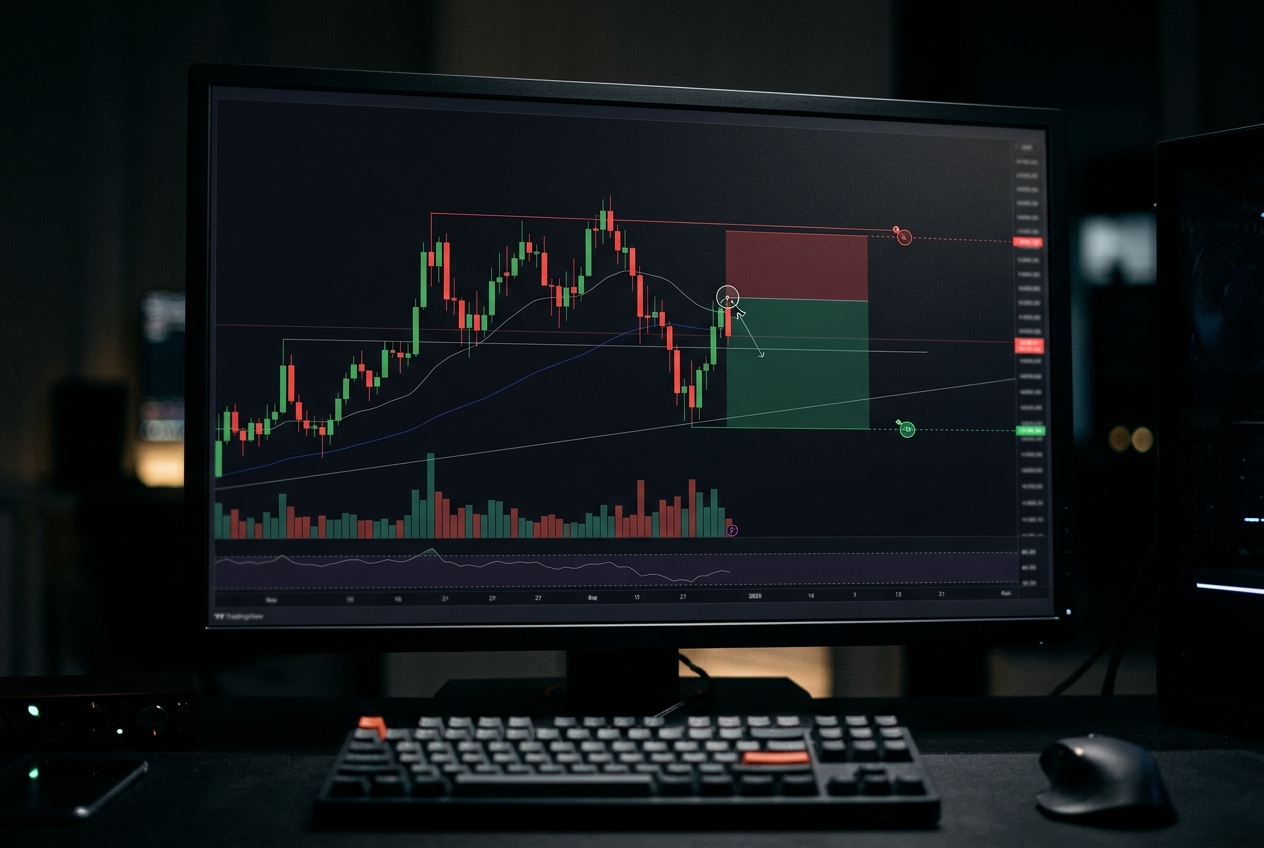
Two traders with the same entries and different position sizes have different careers. The formula is the difference.
EVIDENCE LABEL — Education — arithmetic, universally applicable
Everything in trading that gets discussed — entries, indicators, macro views — is second-order compared to position size. Two traders taking identical trades with 0.5% and 5% risk per trade will, over any meaningful horizon, have completely different outcomes. One compounds; the other's path contains a drawdown that ends the story.
Fixed-fractional risk, the workhorse
Risk a fixed fraction of current equity per trade: size = (equity × risk%) ÷ (entry − stop). It self-corrects — sizes shrink in drawdowns, grow in gains — and it makes ruin arithmetically slow. The subtleties are in the inputs: the stop distance must include the spread, and the risk% must survive your worst historical streak twice over.
The three questions before every trade
- What exact price invalidates this idea? That is your stop — set by structure, not by pain tolerance.
- What rupee amount, at current equity, is an acceptable loss here? That is the risk budget.
- Does the resulting size, divided by the stop distance, round to something your account and the venue can actually execute?
METHODOLOGY
Standard fixed-fractional money management; derivations shown inline in the linked calculators.
LIMITATIONS
Sizing rules manage distribution of outcomes, not certainty; gaps through stops can exceed any planned risk.
SOURCES & CITATIONS
DISCLOSURE
This article is independent editorial analysis for information and education. It is not investment advice, a recommendation, or an offer to trade any instrument. Markets involve risk of loss; past or illustrative performance never guarantees future results.